


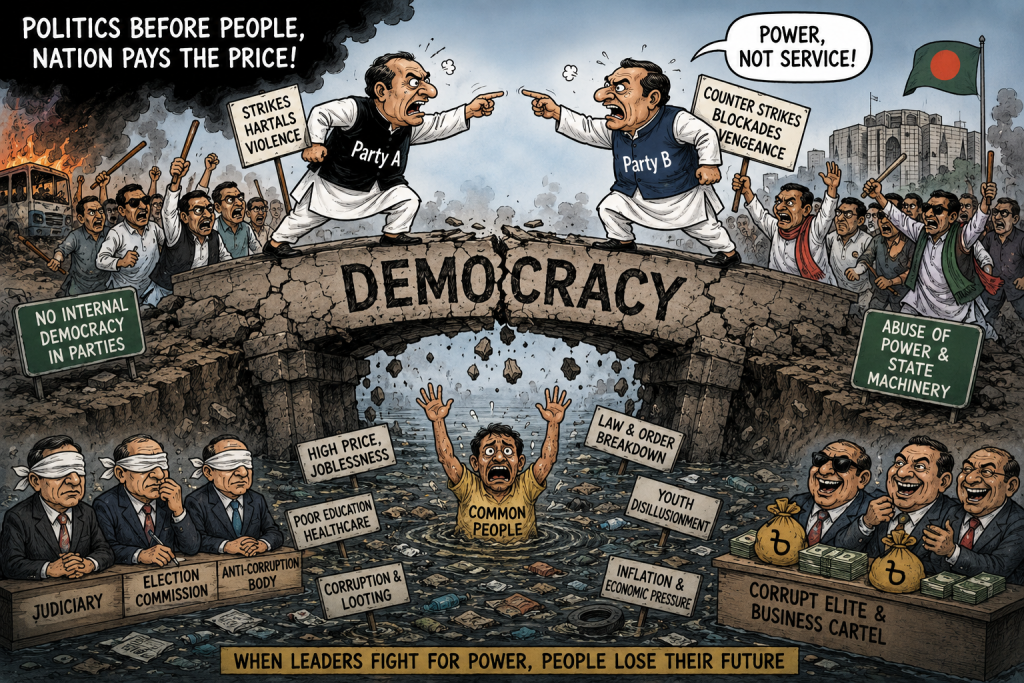
Bangladesh is currently passing through a complex and sensitive political period. The growing political polarization, lack of trust among major political forces, confrontational politics, and declining public confidence in democratic institutions have become serious challenges for the nation’s stability and future progress. While differences of opinion are natural in any democracy, when those differences turn into hostility, violence, and political vengeance, the consequences become deeply harmful for the country and its people.
The people of Bangladesh have always aspired for peace, stability, economic opportunity, and democratic governance. However, prolonged political uncertainty affects not only governance but also the daily lives of ordinary citizens. Business activities, investment, education, and social harmony often suffer during periods of political unrest. Furthermore, instability can negatively impact Bangladesh’s international image at a time when the nation seeks greater global partnerships and economic growth.
The younger generation, in particular, hopes for a more inclusive and tolerant political culture — one where freedom of expression, human rights, and the rule of law are respected regardless of political affiliation. They seek a Bangladesh where political competition is based on ideas, policies, and public service rather than division and confrontation.
At this critical moment, national dialogue has become more important than ever. History has repeatedly shown that no nation can achieve sustainable progress through endless political conflict. Constructive engagement, mutual respect, and democratic compromise are essential for overcoming political crises. Political parties must rise above narrow partisan interests and place the welfare of the nation above all else.
Restoring public trust in electoral processes, constitutional institutions, and the justice system is equally important. A credible democratic environment can only be built when citizens feel that their voices matter and their rights are protected. Strong institutions, transparency, and accountability are the foundations of a healthy democracy.
Civil society, the media, intellectuals, and human rights organizations also have a significant role to play. Responsible journalism, fact-based public discussion, and constructive criticism can help strengthen democratic values and social cohesion. At the same time, efforts must be made to counter misinformation, political hatred, and divisive rhetoric on social media platforms.
Bangladesh is a nation of immense potential. Over the years, the country has made remarkable progress in economic development, technology, education, and international engagement. Yet without political stability and national unity, these achievements may not be sustainable in the long run.
The need of the hour is tolerance, dialogue, democratic maturity, and a renewed commitment to national unity. All political stakeholders, civil society actors, and citizens must work together to build a peaceful, democratic, and inclusive Bangladesh. Such a future would not only safeguard the country’s progress but also serve as a lasting legacy for future generations.
— Editorial Desk, UNIPA News