


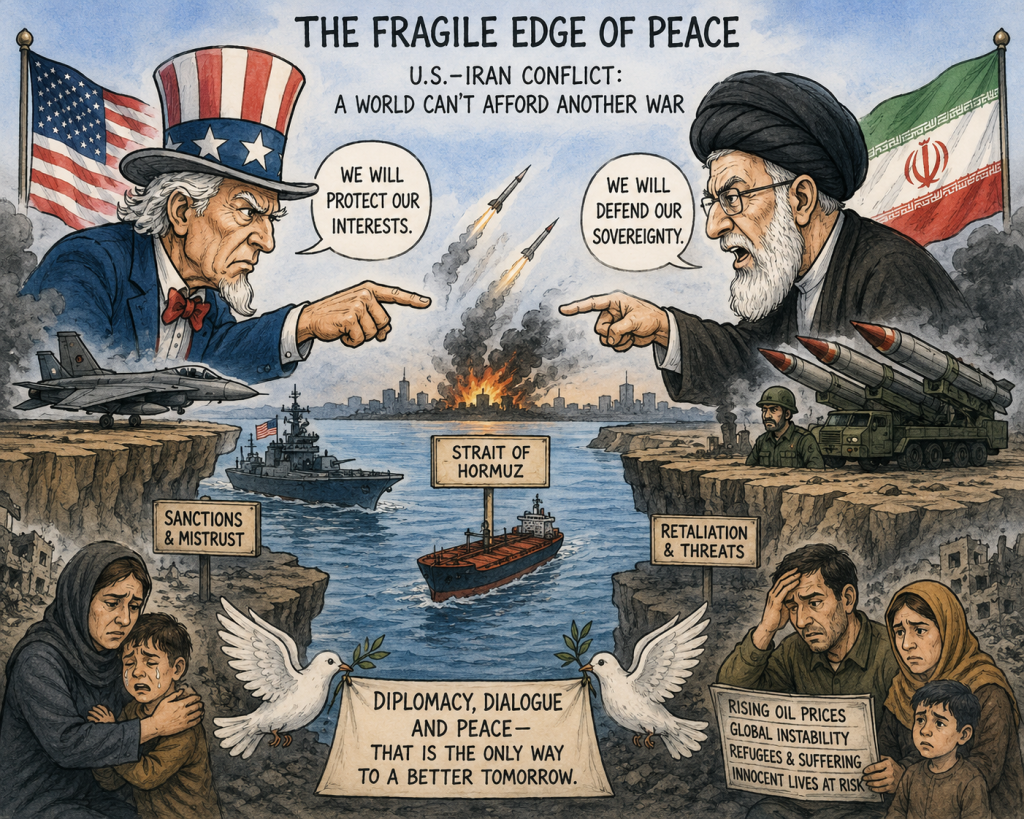
The ongoing tension between the United States and Iran has once again pushed the Middle East to the brink of instability. Although both nations have avoided a full-scale declared war, recent military strikes, naval confrontations in the Strait of Hormuz, and rising political hostility have created a dangerous atmosphere that threatens regional and global peace.
Recent reports suggest that U.S. forces launched targeted strikes on Iranian military facilities and vessels after accusing Iran of threatening American troops and commercial shipping routes. Iran, in return, warned of “strong retaliation” and claimed that American actions violated an already fragile ceasefire. At the same time, diplomatic negotiations continue in places like Qatar, showing that both sides still understand the devastating consequences of direct war.
One of the most critical issues in this conflict is the Strait of Hormuz, a narrow but strategically vital waterway through which a significant portion of the world’s oil supply passes. Any disruption there immediately affects global fuel prices and economic stability. In recent weeks, oil prices have sharply increased due to fears that the conflict may escalate further.
The roots of the U.S.–Iran conflict are deep and historical. Decades of mistrust, sanctions, nuclear disputes, regional power struggles, and proxy wars have shaped the hostile relationship between the two nations. The United States accuses Iran of supporting militant groups across the Middle East and pursuing aggressive military ambitions. Iran, on the other hand, views American military presence and sanctions as acts of oppression and interference in its sovereignty.
However, war is never a true solution. A prolonged conflict between the United States and Iran would not only destroy lives in the Middle East but also destabilize the global economy, increase refugee crises, and deepen political divisions worldwide. Ordinary civilians—rather than political leaders—always pay the highest price during war.
What is most concerning today is the uncertainty. While negotiations are ongoing, military activities continue simultaneously. This contradiction creates an environment where even a minor mistake or misunderstanding could trigger a larger catastrophe.
The international community must therefore play a stronger role in encouraging diplomacy over aggression. Peaceful dialogue, mutual respect, and responsible leadership are essential if both nations hope to avoid another devastating Middle Eastern war.
In the end, history repeatedly teaches humanity one painful lesson: wars may begin with political decisions, but their consequences are carried by ordinary people for generations.