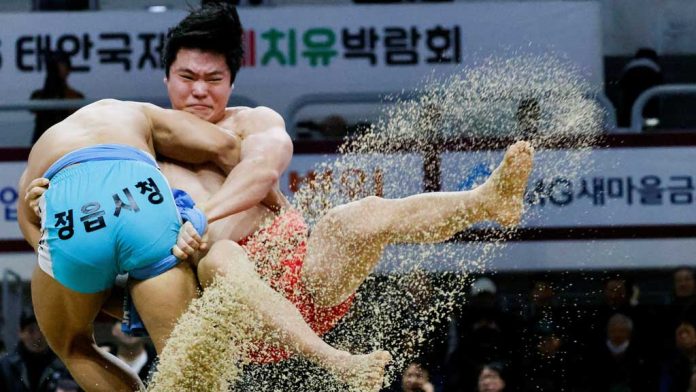

UNIPA News(Seoul) 01 March,2026: As South Korea’s cultural influence continues to surge worldwide through K-pop, cinema and television, one of its oldest sporting traditions is quietly battling decline at home. Ssireum, Korea’s traditional style of wrestling, is finding it increasingly difficult to capture public attention in a rapidly changing entertainment landscape.
Pronounced “see-room,” ssireum enjoyed peak popularity during the 1980s and early 1990s. At that time, the country boasted up to eight professional teams, and leading wrestlers were celebrated as national celebrities. However, shifting public interests and tightening financial support have gradually pushed the sport to the margins.
Twenty-year-old Lee Eun-soo represents a new generation determined to keep the tradition alive. Having begun training at just nine years old, Lee is competing in this year’s Lunar New Year tournament, one of the most prominent events in the sport’s calendar. With a history spanning more than 1,500 years, the tournament remains a symbolic showcase of Korea’s wrestling heritage.
Yet the challenges facing ssireum are evident. Lee revealed that his former high school’s ssireum team currently has no members and may soon be disbanded.
“I once tried to imagine my life if I hadn’t done ssireum,” Lee said. “I don’t think I could live without it.”
A typical ssireum match takes place in an eight-metre sand ring, where two competitors grip each other’s cloth belt, known as a satba. Victory requires not only physical strength but also balance, technique, timing and endurance to bring the opponent to the ground.
In 2018, ssireum was inscribed on UNESCO’s Representative List of the Intangible Cultural Heritage of Humanity, a recognition intended to preserve and promote traditional practices. However, international acknowledgment has yet to translate into widespread commercial success.
The sport’s limited visibility stands in contrast to Japan’s sumo wrestling, which benefits from a centralized professional ranking system and six major annual tournaments. Olympic wrestling, too, enjoys global exposure and institutional backing. By comparison, ssireum remains largely confined to domestic competitions.
Lee Tae-hyun, a former ssireum wrestler and now Professor of Martial Arts at Yong In University, believes the sport has untapped commercial potential if supported strategically. Having worked to promote ssireum overseas, he argues that public engagement depends heavily on visibility and recognition.
“Sport is something people won’t come to watch if they don’t know the wrestlers or even the sport itself,” he said.
Among spectators at the Lunar New Year tournament was 25-year-old Lee Hye-soo, who noted that many younger Koreans are unfamiliar with the sport.
“My grandfather liked watching ssireum, so I watched it with him a lot when I was young,” she said. “I like it now too, but I think it would be even better if it became more famous.”
As South Korea continues to export its contemporary culture to the world, the future of ssireum may depend on whether renewed investment and public interest can restore pride in one of the nation’s oldest sporting traditions.