


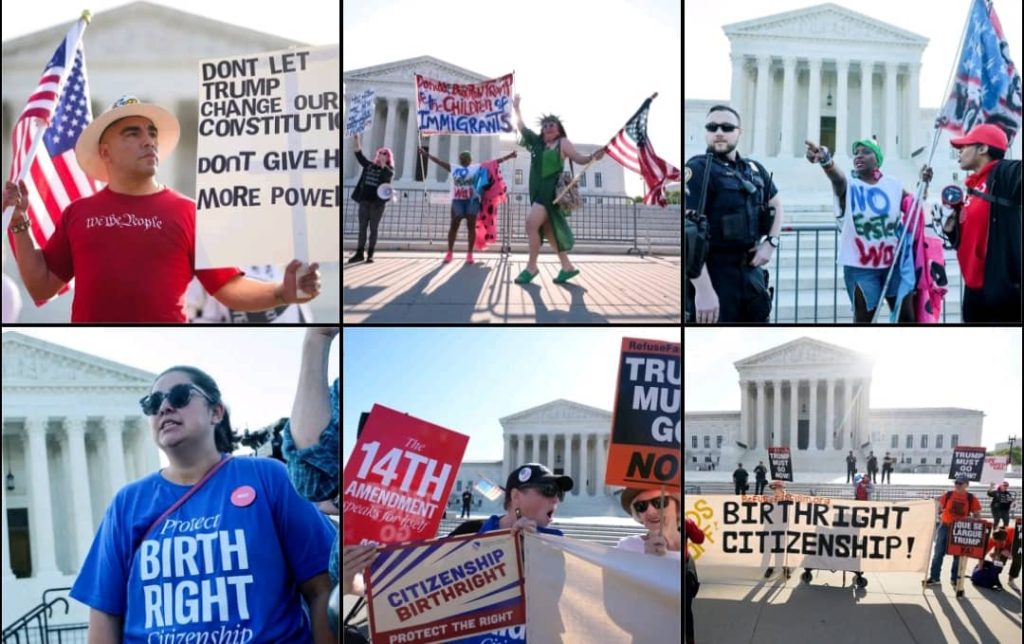
UNIPA News:On 1st April the United States Supreme Court is holding a highly anticipated hearing on President Donald Trump’s executive order aimed at limiting the constitutional guarantee of birthright citizenship for children born on U.S. territory whose parents are undocumented migrants or temporary residents.
President Donald Trump is present at the hearing, marking an unusual and historically significant moment, as it is rare for a sitting U.S. president to attend Supreme Court proceedings in person. Outside the Court, large crowds have gathered—some supporting the initiative, while others strongly oppose it, reflecting a deeply divided national debate.
Journal Analysis & Commentary
The issue at the center of this legal confrontation is one of the most fundamental principles in American constitutional law: citizenship by birth on U.S. soil, commonly known as jus soli.
This principle is strongly grounded in the 14th Amendment of the United States Constitution, which states:
“All persons born or naturalized in the United States, and subject to the jurisdiction thereof, are citizens of the United States and of the state wherein they reside.”
This amendment, adopted in 1868 after the Civil War, was designed to guarantee equal citizenship rights—particularly to formerly enslaved people and their descendants—and has since been interpreted as the legal foundation of birthright citizenship in the United States.
Fragility of the Current Political Decision
The executive order proposed by President Donald Trump raises significant concerns about constitutional stability and legal fragility.
First, the Constitution is the highest legal authority in the United States, and any executive attempt to redefine citizenship risks creating a direct conflict between the presidency and constitutional interpretation. Such tension places the judiciary—especially the Supreme Court—in a position of institutional confrontation with the executive branch.
Second, this policy direction introduces legal uncertainty for newborn children, who could be born in a country without guaranteed recognition as citizens. This uncertainty weakens one of the most stable protections in U.S. constitutional history.
Risk of Family Separation
Human rights observers warn that restricting birthright citizenship could increase family fragmentation and long-term separation issues. If children born in the United States are not automatically recognized as citizens, families may face:
Complicated immigration status disputes
Risk of deportation or forced relocation
Legal separation between parents and children
Psychological and social instability for affected children
These consequences extend beyond legal interpretation and touch deeply on human dignity and family unity.
Broader Constitutional Implications
At the heart of this debate is a tension between executive authority and constitutional permanence. Critics argue that modifying such a foundational principle through executive action rather than constitutional amendment undermines institutional balance.
Supporters, however, claim that immigration pressures require stricter interpretations of citizenship law. This clash illustrates the ongoing struggle in American politics between national sovereignty concerns and constitutional protections.
Conclusion
The Supreme Court’s decision in this case could redefine how the United States interprets one of its oldest constitutional guarantees. Regardless of the outcome, the debate highlights the fragility of policy-making when it collides with entrenched constitutional rights.
What remains clear is that the 14th Amendment continues to stand as the central legal safeguard of birthright citizenship in the United States, and any attempt to alter its interpretation will have profound legal, political, and human consequences.
Report by: SIONEL YOUTE
UNIPA NEWS HAITI