

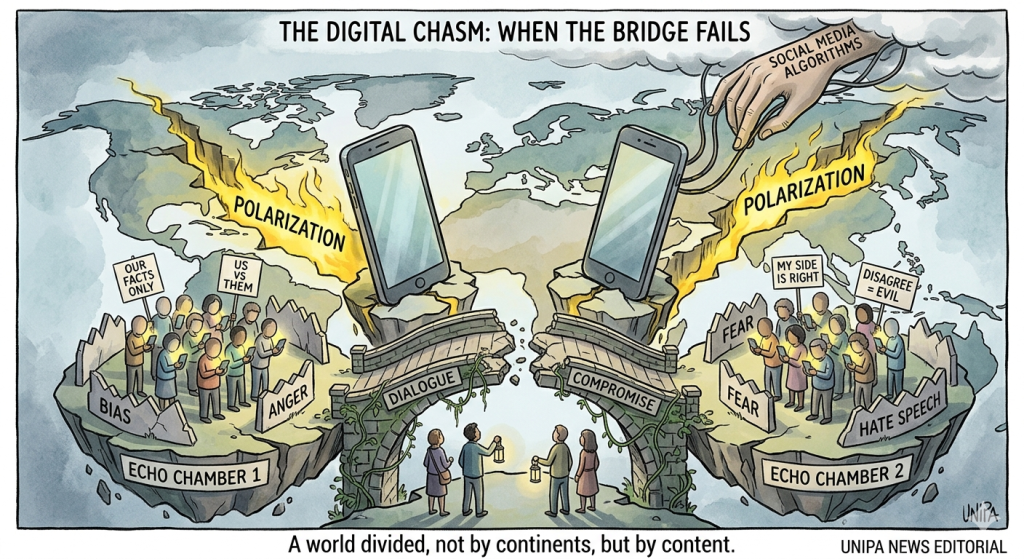
In the modern era, the most dangerous borders are no longer the ones drawn on maps, but the invisible lines drawn in our minds. Digital Polarization—the process by which social media and hyper-partisan algorithms divide society into “us vs. them”—has emerged as a burning issue that threatens the very foundation of global social harmony.
The Echo Chamber Effect
At the heart of this crisis is the “Echo Chamber.” Algorithms designed to maximize engagement prioritize content that triggers strong emotional responses—often anger or fear. As a result, users are increasingly exposed only to information that reinforces their existing biases. We are no longer debating different opinions based on the same facts; we are living in different realities entirely.
A Threat to Social Fabric
This digital tribalism has real-world consequences. From political instability and civil unrest to the rise of hate speech, the erosion of nuance is visible everywhere.
- The Loss of Dialogue: In a polarized world, compromise is seen as weakness, and civil conversation is replaced by digital warfare.
- The Mental Health Toll: The constant exposure to conflict and “outrage culture” is fueling a global crisis of anxiety and social isolation.
Beyond the Screen: Seeking Solutions
To douse the flames of this growing divide, the responsibility must be shared:
- Tech Accountability: Social media giants must be pressured to move away from “outrage-based” profit models and prioritize the accuracy and diversity of information.
- Media Literacy: Governments and educational institutions must prioritize digital literacy, teaching citizens how to identify propaganda and engage in healthy skepticism.
- Human Connection: We must actively seek out perspectives that challenge our own. True progress happens in the “gray areas,” not in the extremes of the black-and-white digital world.
The Path Forward
For UNIPA News readers and the global community, the message is clear: technology should be a bridge, not a barrier. As we move further into the digital age, our greatest challenge will be to reclaim the art of listening. We must ensure that the tools built to connect us do not become the very instruments that tear us apart.
The burning question is no longer just about how we connect online, but how we remain human together in a divided world.


