
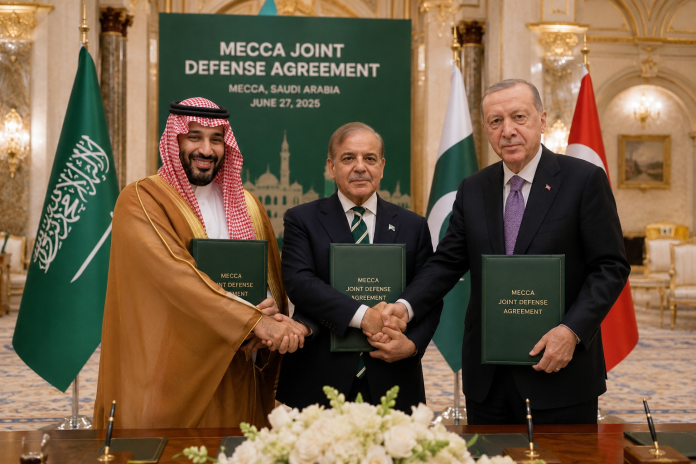

UNIPA News| London-Saudi Arabia, Pakistan and Turkey have signed a new defense agreement under which an armed attack against any one of the three countries will be regarded as an attack against all three, signaling closer security coordination amid growing tensions involving Iran and renewed attacks by Yemen-based Houthi forces.
The Mecca Joint Defense Agreement was signed in Mecca on Friday as Gulf states reassess regional security arrangements and question the reliability of the United States as their primary security provider following repeated Iranian drone and missile attacks.
The agreement is significant for Saudi Arabia, but it does not establish a NATO-style military alliance or create a clearly defined new regional bloc.
For Riyadh, the agreement provides an additional mechanism to strengthen its position amid mounting regional security challenges and growing concerns over Iran. Saudi Arabia has increasingly pursued a broader network of strategic partnerships rather than relying exclusively on a single security partner.
The agreement also reinforces Saudi Arabia’s effort to project itself as a leading regional security actor. By hosting the agreement with Turkey and Pakistan, Riyadh is seeking to strengthen its diplomatic and strategic influence at a time when regional tensions remain high.
Saudi Arabia already has mutual defense arrangements with Pakistan and with the six-member Gulf Cooperation Council. However, previous agreements have not produced a collective military response comparable to NATO’s Article 5 commitment.
The practical military implications of the new agreement are therefore likely to depend heavily on the circumstances of any future conflict. Pakistan and Turkey could provide additional security assistance in response to threats against Saudi Arabia, including from Iran or the Houthis, but the scale and nature of such support would likely be determined on a case-by-case basis.
Pakistan has already deployed troops and air-defense capabilities to Saudi Arabia. Pakistani officials have also previously stated that the country’s existing defense agreement with Riyadh does not provide a nuclear umbrella.
The agreement may consequently have greater diplomatic significance than immediate military impact. Closer ties between Riyadh and Islamabad could give Saudi Arabia additional leverage in managing regional crises and engaging with Tehran during periods of heightened tension.
The agreement also reflects Saudi Arabia’s growing emphasis on diversifying its security partnerships rather than depending solely on Washington for regional protection. However, it does not necessarily indicate a rupture in Saudi-US relations.
Instead, the new arrangement could coexist with Washington’s evolving approach to the Middle East, in which the United States seeks to adjust its direct military role while encouraging regional partners to assume greater responsibility for their own security.
The agreement therefore marks an expansion of Saudi Arabia’s regional security network, while its ultimate significance will depend on whether the three countries translate the political commitment into sustained military coordination and a coordinated response to future threats.


