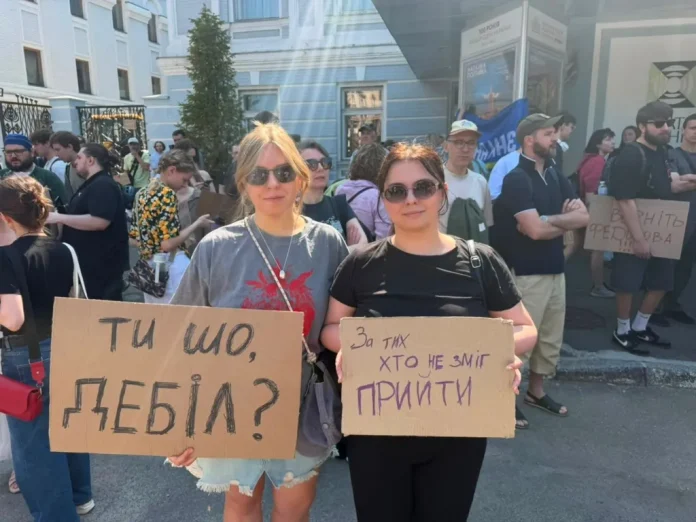

UNIPA NEWS| 16 July-KYIV, Ukraine — Protests erupted in several Ukrainian cities on Thursday after President Volodymyr Zelensky dismissed Defence Minister Mykhailo Fedorov, a move that has triggered criticism from sections of the military, political observers, and civil society.
Demonstrators, many of them young people, gathered in central Kyiv carrying placards reading “Hands off Fedorov” and “Stop Sabotaging Victory!” while chanting slogans against the decision. Similar protests were reported in other Ukrainian cities.
The dismissal followed months of reported disagreements between Fedorov and Ukraine’s Commander-in-Chief, General Oleksandr Syrskyi. Speaking at a press conference, Fedorov confirmed that he had recommended replacing both Syrskyi and Chief of the General Staff Andrii Hnatov, arguing that military leadership needed significant changes.
President Zelensky acknowledged that tensions between the Defence Ministry and the General Staff had become “systemic” and said cooperation between Fedorov and Syrskyi had required his personal mediation. According to Fedorov, after Zelensky indicated that Syrskyi would remain in his post, he agreed to continue working with the military chief but claimed that key defence initiatives proposed by his ministry were subsequently blocked.
Fedorov accused Syrskyi of failing to pursue innovative military strategies, arguing that internal divisions had weakened Ukraine’s wartime decision-making.
General Syrskyi responded briefly on Telegram, expressing pride in Ukraine’s defence of Kyiv during the early stages of Russia’s full-scale invasion in 2022 and stating that he would remain focused on the war and military strategy. He also wished Fedorov success in the future.
Appointed Defence Minister in January, the 35-year-old Fedorov was widely credited with accelerating reforms within the ministry, strengthening anti-corruption measures, improving procurement systems, and expanding the use of data-driven analysis to support battlefield operations.
Before leading the Defence Ministry, Fedorov served as Minister of Digital Transformation, where he helped establish Ukraine’s volunteer “IT Army,” promoted drone development initiatives, and advanced the integration of digital technologies into military planning. As Defence Minister, he continued to prioritise drone warfare, technological innovation, and defence modernisation.
Fedorov also revealed that President Zelensky had offered him a position as a presidential adviser following his dismissal, but he declined the offer. He said he was acting according to his conscience while expressing confidence that the president would ultimately resolve the leadership dispute.
Despite his criticism of the decision, Fedorov said he was not seeking confrontation with Zelensky and maintained that the president remained responsive to public opinion.
The dismissal has prompted criticism from some military personnel and officials. Several current and former defence figures described the move as a setback for Ukraine’s military reforms, while supporters praised Fedorov’s efforts to modernise the armed forces and streamline defence administration.
Among those voicing concern was drone unit commander Pavlo Yelizarov, who resigned from his position as deputy commander of the Ukrainian Air Force in protest, describing the dismissal as harmful to Ukraine’s defence capabilities.
Ukraine’s parliament has yet to approve a successor. President Zelensky said Interior Minister Ihor Klymenko is among the candidates under consideration but noted that no formal nomination has been submitted.
The leadership change comes as Ukraine continues to confront Russia’s full-scale invasion while balancing military operations with efforts to reform its defence institutions and maintain public confidence in wartime leadership.