
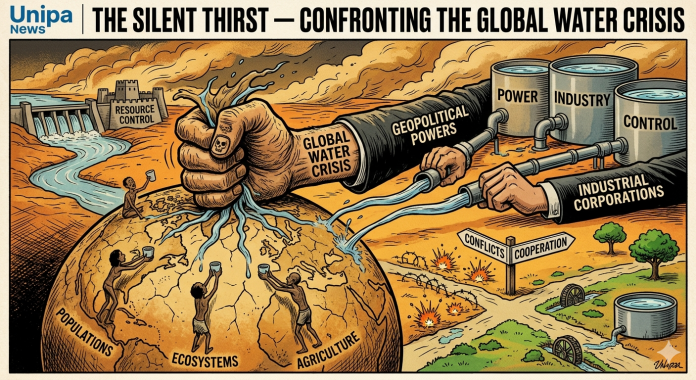

The world is currently standing at a precarious crossroads, facing a challenge that is as fundamental as life itself: the escalating global water crisis. While climate change and energy transitions often dominate the headlines, the depletion of our freshwater resources is a silent emergency that threatens the stability of nations, the health of ecosystems, and the very survival of billions.
A Scarcity by Design
Water is technically a renewable resource, but our management of it has been anything but sustainable. According to recent data, nearly two billion people currently live in countries experiencing high water stress. This isn’t just a “dry climate” problem; it is a systemic failure driven by:
- Agricultural Inefficiency: Roughly 70% of global freshwater is used for agriculture, often through outdated irrigation methods.
- Industrial Pollution: Untreated waste continues to turn life-sustaining rivers into toxic channels.
- Rapid Urbanization: Mega-cities are expanding faster than the infrastructure required to provide clean water and sanitation.
The Geopolitical Ripple Effect
We must recognize that water is no longer just a domestic utility; it is a geopolitical flashpoint. As transboundary rivers dry up, the potential for “water wars” increases. From the Nile to the Indus, the competition for upstream control is creating diplomatic friction that could easily boil over into conflict. Peace in the 21st century will be written in the language of hydro-diplomacy.
The Path Forward: Innovation and Policy
Solving this crisis requires more than just “saving drops.” It demands a radical shift in how we value water.
- Investment in Tech: We must scale up affordable desalination and wastewater recycling technologies. “Waste” water should be viewed as a resource, not a byproduct.
- Regenerative Agriculture: Shifting toward crops and farming techniques that require less hydration is no longer optional—it is a necessity.
- Global Governance: We need stronger international frameworks to manage shared water bodies fairly, ensuring that downstream communities aren’t left in the dust.
“Water is the driving force of all nature.” — Leonardo da Vinci
If we continue to treat water as an infinite commodity rather than a finite treasure, we are not just risking an environmental disaster; we are bankrolling a human catastrophe. The time for passive observation has passed. For Unipa News and the global community, the mandate is clear: we must protect our liquid gold before the wells—and our future—run dry.


