
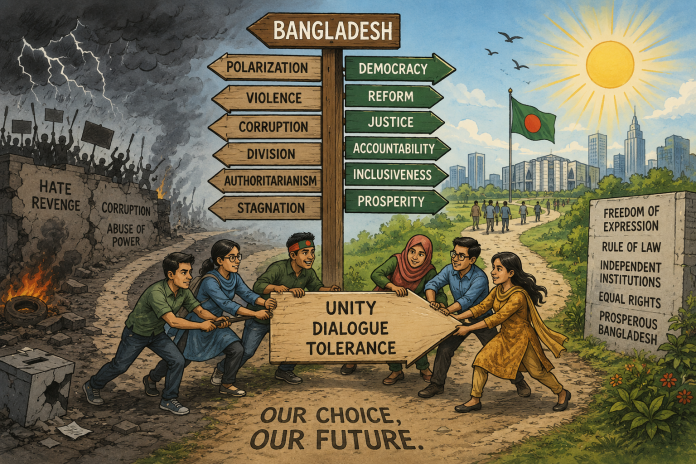

Bangladesh is once again standing at a defining moment in its political history. After years of political turbulence, mass protests, institutional confrontations, and a dramatic transition of power, the nation now faces a critical question: can Bangladesh transform political change into democratic stability, or will it return to the cycle of polarization that has long hindered its progress?
The political landscape of Bangladesh has changed profoundly since the 2024 mass uprising that led to the fall of the long-standing government of Sheikh Hasina. The subsequent interim administration under Nobel laureate Muhammad Yunus promised reforms, accountability, and democratic renewal. Later, the 2026 national election returned elected governance through a decisive victory for the Bangladesh Nationalist Party (BNP), while constitutional reform debates reshaped national discourse.
However, the transition from revolution to responsible governance is never easy. The expectations of the people are extraordinarily high. Citizens want more than slogans and political rivalry; they demand economic stability, justice, institutional independence, freedom of expression, and an end to corruption and violence.
Bangladesh today faces a complex political reality. On one hand, there is renewed hope for democratic participation and institutional reform. On the other hand, concerns remain regarding political inclusiveness, the weakening of opposition space, and the future of democratic pluralism. Analysts and international observers have warned that excessive political dominance by any single force could once again damage democratic balance.
The country’s youth — particularly the generation that played a central role in the 2024 movement — are no longer willing to remain silent spectators. They seek a politics based on merit, transparency, and accountability rather than dynastic control and confrontational culture. Their aspirations represent both a challenge and an opportunity for Bangladesh’s traditional political parties.
At the same time, Bangladesh’s economic future cannot be separated from political stability. Foreign investment, industrial growth, diplomatic confidence, and employment generation all depend on a functioning democratic environment and predictable governance. Political revenge, street violence, and institutional uncertainty only weaken the nation internationally and discourage long-term development.
Another major challenge lies in rebuilding trust in state institutions. For years, allegations surrounding electoral credibility, judicial independence, media pressure, and human rights violations have deeply polarized society. Reform efforts initiated after the political transition created optimism, but recent debates over reversing or slowing reforms have triggered fresh public concern.
Bangladesh must therefore avoid the dangerous temptation of “winner-takes-all” politics. Democracy is not merely about winning elections; it is about protecting dissent, respecting institutions, and ensuring equal political space for all citizens. Sustainable national unity can only emerge through dialogue, tolerance, and constitutional fairness.
The role of civil society, independent media, academia, and international partners will also remain crucial during this sensitive period. Constructive criticism should not be viewed as hostility, but rather as an essential pillar of democratic maturity. A nation grows stronger when institutions are allowed to function independently and citizens can express opinions without fear.
Despite its challenges, Bangladesh possesses enormous potential. The country has demonstrated remarkable resilience throughout its history — from the Liberation War to economic progress and social development. Its young population, strategic geographic position, and expanding global influence provide a strong foundation for the future.
But the future of Bangladesh will ultimately depend not only on political leaders, but also on the collective wisdom of its people. The nation now requires statesmanship over confrontation, reform over rhetoric, and unity over division.
History has given Bangladesh another opportunity to redefine its democratic journey. Whether this moment becomes a new beginning or another missed opportunity will depend on the courage, vision, and responsibility of all political stakeholders.
Dr.Muhammed Haider Ali,Editor in Chief -UNIPA News


