
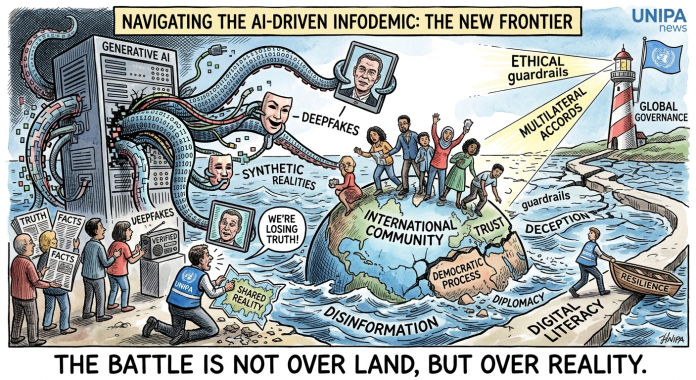

We live in an era where seeing is no longer believing. As we navigate through 2026, the global community faces an unprecedented challenge that does not merely threaten our digital infrastructure, but strikes at the very foundation of democratic trust, human rights, and international diplomacy: the weaponization of artificial intelligence and advanced deepfakes.
Historically, global conflicts were fought over physical territories and tangible resources. Today, the battleground has shifted significantly into the cognitive realm. The rapid democratization of generative AI tools has allowed non-state actors, rogue entities, and malicious political machines to manufacture synthetic realities at zero cost and scale them globally with the click of a button. From hyper-realistic deepfakes altering political discourse during critical elections to synthetically engineered voice clones triggering financial panic, the boundary between truth and fabrication has been dangerously blurred.
For an organization like the United Nations Inter-Pacific Association (UNIPA), whose mission is anchored in “Diplomacy Beyond Borders,” this crisis demands immediate attention. Traditional diplomacy thrives on a shared baseline of facts. When nations and communities can no longer agree on verified reality, the space for dialogue shrinks, and the potential for volatile conflict expands exponentially.
Consider the impact on human rights and gender equality—core pillars of UNIPA’s global mission. Generative AI is being disproportionately weaponized to target female leaders, journalists, and activists through synthetic harassment and character assassination, aiming to silence vulnerable voices and widen the digital gender gap. Furthermore, as the digital divide persists across the Inter-Pacific region, underserved communities lack the critical digital literacy required to decipher AI-generated propaganda, making them primary targets for systematic disinformation.
We must recognize that this is not just a technological challenge; it is a profound ethical and human rights crisis. Technology sectors have long hidden behind the veil of self-regulation, but the current socio-political climate proves that corporate goodwill is entirely insufficient.
To bridge this fracturing global landscape, a three-pronged approach is urgently required:
- Global Regulatory Frameworks: Just as the world unified to govern nuclear proliferation and climate change, we need enforceable, cross-border legal frameworks for AI governance. Tech conglomerates must be held legally accountable for the downstream impacts of their algorithms.
- Decentralized Fact-Checking Networks: Investing in grassroots, transnational fact-checking mechanisms—particularly in developing regions—is essential to build local resilience against foreign information manipulation.
- Inclusive Digital Literacy: Universal digital education must be recognized as a fundamental human right. Citizens must be equipped with the cognitive tools to cross-examine digital content critically.
As an international alliance dedicated to peacebuilding, sustainable development, and rights protection, UNIPA has a pivotal role to play. We must leverage our global platforms to champion inclusive diplomacy that brings tech giants, policymakers, and civil society to the same table.
The digital future should be a tool for empowerment and cross-cultural unity, not a weapon of mass deception. If we fail to establish ethical guardrails today, we risk surrendering the very fabric of human trust to automated malice. The time for reactive policy is over; proactive global governance is the only path forward.


