
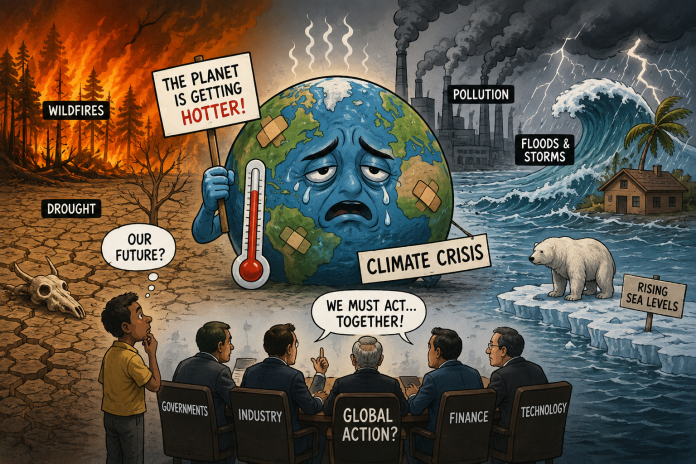

Global climate risks are intensifying as record-breaking temperatures, extreme weather events, prolonged droughts, floods, and wildfires continue to affect multiple regions across the world. Governments, international organizations, scientists, and economic institutions are warning that climate-related disruptions are no longer a future concern but an immediate challenge with growing humanitarian, environmental, and economic consequences.
Recent developments indicate that climate impacts are placing increasing pressure on food security, public health systems, water resources, energy infrastructure, and global supply chains. Vulnerable populations, particularly in developing and climate-sensitive regions, are experiencing disproportionate effects. At the same time, industrialized nations are facing mounting costs from disaster recovery, infrastructure damage, and insurance losses.
Experts note that while international agreements have established long-term emission reduction targets, implementation gaps remain significant. Many countries continue to struggle with balancing economic growth, energy security, and environmental commitments. The pace of renewable energy adoption has accelerated in several markets, yet fossil fuels continue to account for a substantial share of global energy consumption.
The debate surrounding climate policy has also expanded beyond emissions reduction. Adaptation measures, climate financing, technological innovation, disaster preparedness, and loss-and-damage compensation have become central issues in international negotiations. Developing nations have repeatedly called for greater financial and technical support to address challenges they argue were largely created by historical emissions from wealthier economies.
From a governance perspective, the climate crisis presents a complex test of international cooperation. Policymakers face difficult decisions regarding investment priorities, regulatory frameworks, industrial transformation, and social equity. The effectiveness of future responses will depend not only on national policies but also on the ability of countries to coordinate actions across borders.
As climate-related events become more frequent and severe, the issue is increasingly being viewed as a multidimensional global challenge affecting security, development, public health, and economic stability. The coming years are expected to play a decisive role in determining whether current commitments can be translated into measurable outcomes capable of reducing long-term risks.
UNIPA News Editorial Desk


