

UNIPA News DESK|| An international team of researchers has detected complex organic matter within ancient sedimentary rocks on Mars, marking what scientists describe as the strongest evidence of organic material yet identified in the planet’s Jezero Crater.
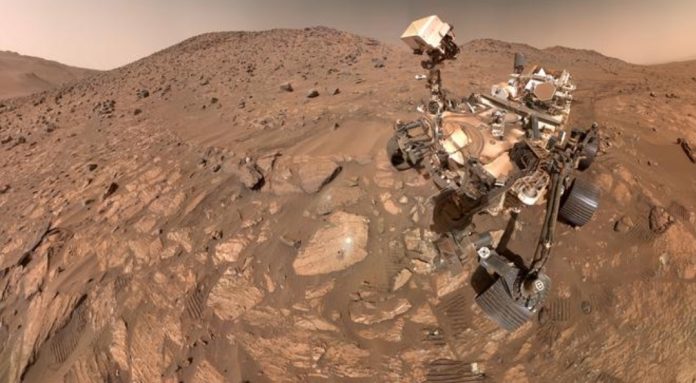
The findings, published in Science Advances, are based on observations made by NASA’s Perseverance rover inside Jezero Crater, a site believed to have once hosted an ancient river delta and lake environment.
Using the rover’s SHERLOC instrument, researchers identified macromolecular carbon—a complex and chemically resilient form of organic matter—embedded within fine-grained mudstones. According to the study, this represents the most robust detection of organic material in Jezero Crater to date.
The research also marks the first time macromolecular carbon has been identified directly on the natural surface of a Martian rock, rather than in drilled samples or meteorites linked to Mars.
Scientists said the organic carbon was found within rocks that formed in an ancient river valley, providing new insight into the planet’s geological history and the preservation of carbon-bearing compounds over billions of years.
The researchers cautioned that the presence of organic matter does not constitute evidence of past or present life on Mars. Organic compounds can be produced through both biological and non-biological processes, and further analysis will be required to determine their origin.
The discovery is expected to help guide future investigations into Mars’ past environment and support ongoing efforts to determine whether the planet once possessed conditions capable of sustaining life.