
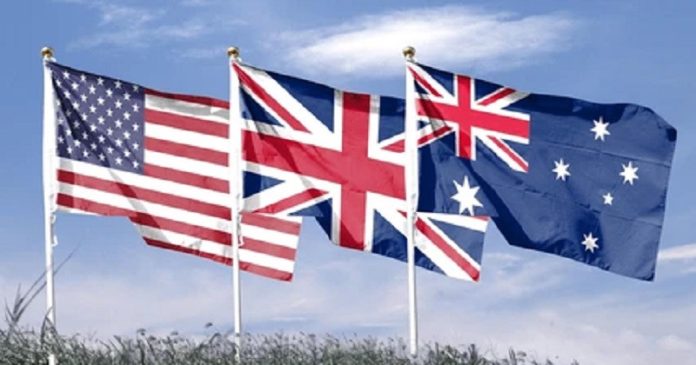

UNIPA News( Washington D.C) 06 June: The United States, the United Kingdom and Australia have announced a joint project under the AUKUS security partnership to develop advanced unmanned underwater vehicles (UUVs) aimed at protecting critical undersea infrastructure and strengthening maritime defense capabilities.
The announcement was made by the defense ministers of the three countries during the Shangri-La Dialogue security summit in Singapore. The new underwater drone system is expected to be operational by next year. While the total cost of the project has not been disclosed, UK Defence Secretary John Healey said Britain would contribute £150 million (approximately $201 million).
The project marks the first major initiative under AUKUS Pillar Two, which focuses on the joint development of advanced military technologies among partner nations. The program will involve the creation of sophisticated underwater systems capable of protecting seabed infrastructure, conducting surveillance, gathering intelligence, supporting logistics operations and carrying out strike missions. Specialized sensors and weapons systems will also be developed for the drones.
The announcement comes amid growing concerns among Western allies over the security of undersea cables and pipelines that support global communications and energy networks. Officials from the three countries argue that the new technology will help enhance deterrence and operational capabilities across the Pacific, Atlantic and Arctic regions.
John Healey acknowledged criticism over the slow pace of progress within the AUKUS framework since its launch in 2021. He said that while discussions had dominated the partnership in its early years, the current governments were now delivering tangible outcomes.
AUKUS was established in 2021 to deepen defense cooperation among the United States, the United Kingdom and Australia. The agreement includes plans for nuclear-powered submarines and collaboration on advanced military capabilities such as hypersonic weapons, artificial intelligence and underwater robotics.
The partnership is widely viewed as part of broader efforts to address China’s expanding naval presence in the Indo-Pacific region. Concerns over tensions in contested waters, including the South China Sea, have further underscored the strategic importance of the alliance.
Recent security concerns have also focused on the vulnerability of undersea infrastructure. Last month, Healey accused Russia of conducting covert activities targeting cables and pipelines in waters north of the United Kingdom, an allegation Moscow denied. Britain and Norway signed an agreement in December to strengthen monitoring of Russian submarine activity in the North Atlantic and improve the protection of undersea communications networks.
British officials have stated that nearly 60 undersea cables connect the United Kingdom to international networks and that perceived threats to these assets have increased in recent years. Separate incidents involving damaged undersea cables in the Baltic Sea, as well as suspected cases involving vessels near Taiwan and Sweden, have intensified concerns over maritime infrastructure security.
Questions remain regarding the broader AUKUS submarine program under Pillar One. Australia is expected to receive nuclear-powered submarine capabilities through the partnership, but concerns persist over delivery timelines and the retirement of the country’s aging submarine fleet. AUKUS submarines are not expected to enter service until the 2040s.
Until then, the United States and the United Kingdom plan to rotate nuclear-powered submarines through Australia, with Australia expected to acquire used US submarines during the 2030s. Australian Defence Minister Richard Marles recently defended the program, stating that there was no viable alternative to the AUKUS submarine initiative.
US Defense Secretary Pete Hegseth said plans to deploy American and British nuclear-powered submarines to Australia remain on schedule, with the first US Navy personnel expected to arrive later this year. Marles added that HMAS Stirling naval base in Western Australia is expected to be ready to host the submarine force by the end of 2027, while construction of a submarine-building yard in South Australia is progressing rapidly.


