
By UNIPA News
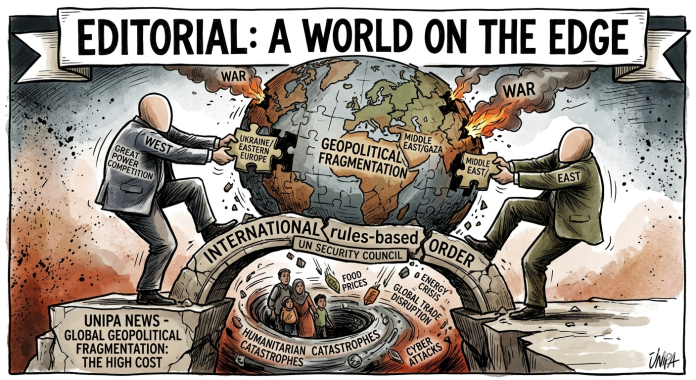
The year 2026 finds the global community at a critical crossroads. The “long peace” that characterized much of the late 20th and early 21st centuries has been replaced by a volatile era of geopolitical friction. From the lingering trenches in Eastern Europe to the scorched landscapes of the Middle East and the simmering tensions in the Indo-Pacific, the world is witnessing a systemic breakdown of the international rules-based order.
The Domino Effect of Conflict
The modern battlefield is no longer confined to territorial borders. In an interconnected world, a missile strike in one hemisphere triggers an economic shockwave in another. The ongoing conflicts have moved beyond localized disputes, evolving into proxy battlegrounds for “Great Power Competition.”
The consequences are no longer abstract; they are measured in the soaring costs of grain, the instability of energy markets, and the disruption of vital maritime trade routes. We are seeing a dangerous trend where diplomacy is often treated as a sign of weakness, and military posturing is the new default language of international relations.
The Erosion of Humanitarian Norms
Perhaps most alarming is the normalization of humanitarian catastrophes. International laws designed to protect civilians are being bypassed with increasing impunity. The paralysis of the UN Security Council—often deadlocked by vetoes—has left a vacuum where global governance should be. When the world’s primary peacekeeping bodies are sidelined, the message sent to aggressors is clear: might, once again, is being framed as right.
The New Fronts: Cyber and Space
Geopolitical tension is no longer limited to land, sea, and air. The silent wars in cyberspace and the militarization of space represent the new frontiers of conflict. Targeted attacks on national power grids, financial systems, and satellite communications have become tools of statecraft, blurring the line between “peace” and “war.”
The Path Forward: Restoring Dialogue
As we navigate these turbulent times, the necessity for a “New Multilateralism” has never been more urgent. The global community must move beyond binary alliances. Economic interdependence, once thought to be a safeguard against war, has instead become a weaponized tool of coercion.
To prevent a total collapse into a multipolar conflict, the world’s leading powers must prioritize “de-risking” over “de-coupling.” We need a return to the negotiating table where the focus is not just on managing crises, but on addressing the root causes of insecurity—inequality, resource scarcity, and the lack of representation for the Global South.
The Bottom Line: The cost of war is always paid by the most vulnerable. If the current trajectory of geopolitical escalation continues, the progress of the last century could be undone in a decade. It is time for the global leadership to realize that in a nuclear-armed, hyper-connected world, there are no true winners in a global conflict—only survivors.