
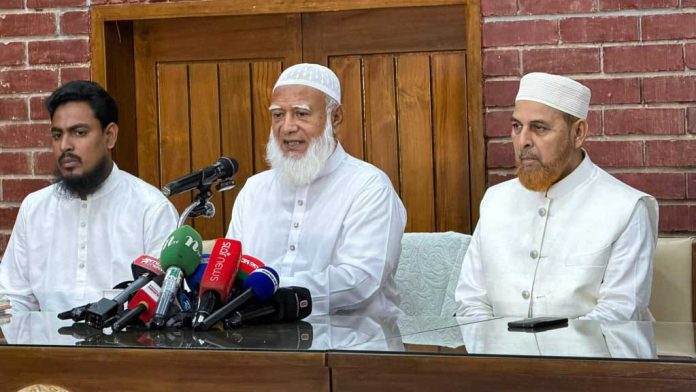

The events that unfolded in Bangladesh’s Parliament yesterday mark a critical moment in the country’s democratic trajectory. The opposition’s dramatic walkout, led by Jamaat-e-Islami Ameer Dr. Shafiqur Rahman, reflects not just parliamentary disagreement, but a deeper political crisis rooted in the interpretation—and alleged disregard—of a public referendum.
At the heart of the controversy lies a fundamental question: What is the value of the people’s mandate in a democracy? Dr. Rahman’s remarks underscore a growing perception among opposition parties that the government has failed to honor the outcome of the referendum—an instrument widely regarded as one of the highest expressions of popular sovereignty. His assertion that “there is no alternative to movement” signals a potential escalation from institutional politics to street mobilization.
Historically, referendums in Bangladesh have played significant roles in shaping constitutional and political directions. The opposition’s claim that previous referendums were respected, while the current one is being sidelined, raises serious concerns about consistency in democratic practices. If true, this could erode public trust not only in the government but also in the broader political framework.
The government, on the other hand, has yet to provide a sufficiently convincing response to these allegations. Silence—or perceived indifference—at such a moment risks deepening political polarization. In a parliamentary democracy, dialogue and accountability are not optional; they are essential.
Equally concerning is the opposition’s announcement of a coordinated movement involving 11 political parties. While peaceful protest is a democratic right, Bangladesh’s political history reminds us that mass movements often carry the risk of instability, especially when trust between stakeholders is already fragile.
Dr. Rahman’s reference to the events of August 2024 adds another layer of complexity. His remarks about a power vacuum, delayed institutional actions, and unmet political expectations point toward unresolved tensions stemming from that transitional period. These questions remain unclear and may further strengthen the foundation of political instability.
This moment calls for restraint, responsibility, and above all, dialogue. The government must clarify its position on the referendum and take steps to reassure citizens that their voice matters. Ignoring or dismissing such concerns may yield short-term political advantage, but it risks long-term institutional damage.
For the opposition, while movement may appear as the only remaining path, it must also ensure that its strategies remain peaceful, constructive, and within democratic norms. The people of Bangladesh do not want to witness another chapter of instability.
In the end, democracy is not tested in times of consensus, but in moments of conflict. Bangladesh now stands at such a juncture. Whether it moves toward deeper democratic consolidation or further political division will depend on the choices made in the days ahead.


