
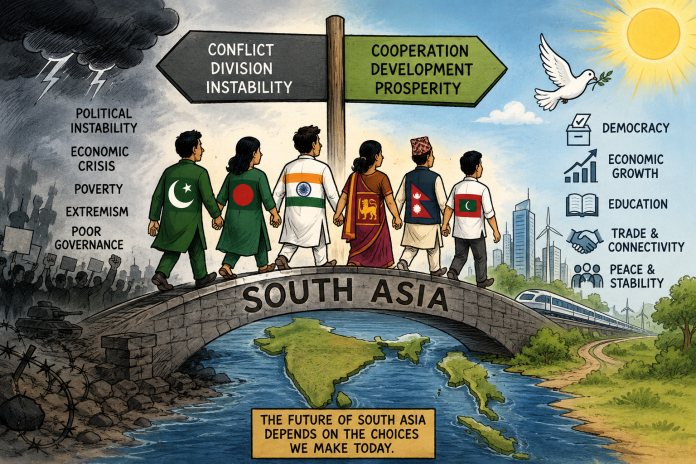

South Asia stands at a critical political crossroads. Home to nearly one-fourth of the world’s population, the region has become increasingly significant in global politics, economics, and security discussions. Countries such as Bangladesh, India, Pakistan, Sri Lanka, Nepal, and the Maldives are experiencing rapid political transformations shaped by internal challenges and international influence. As a result, South Asian politics today reflects both instability and immense potential.
One of the most pressing concerns across the region is the growing challenge of maintaining democratic stability. Political polarization, electoral tensions, economic hardship, and public dissatisfaction have intensified in several countries. In many cases, political debates are no longer limited to policy differences; they have evolved into struggles over governance, accountability, and national direction. These developments are shaping the future of democracy in South Asia.
At the same time, geopolitical competition among global powers has added another layer of complexity. South Asia has become an important arena for strategic influence, particularly among China, the United States, and India. Infrastructure investments, trade partnerships, and security alliances are increasingly influencing regional political decisions. Smaller nations in the region are now trying to maintain a delicate balance between economic cooperation and political independence.
Economic pressure is also playing a major role in shaping political realities. Inflation, unemployment, energy shortages, and rising living costs have created frustration among ordinary citizens. Governments across South Asia are under growing pressure to deliver economic stability while also addressing social inequality and development challenges. In many countries, economic performance has become directly tied to political legitimacy.
Despite these difficulties, South Asia remains a region of enormous promise. Its youthful population, expanding digital economy, and growing entrepreneurial culture provide strong foundations for future progress. If regional leaders prioritize cooperation over conflict, the region could emerge as one of the world’s most dynamic economic and political centers in the coming decades.
However, achieving that vision will require responsible leadership, stronger democratic institutions, and greater regional collaboration. Political rivalry and division may offer short-term gains for some leaders, but long-term stability can only be achieved through dialogue, transparency, and inclusive governance.
The future of South Asian politics will ultimately depend on whether the region chooses confrontation or cooperation. The decisions made today will not only define national politics but will also shape the destiny of millions across the region.
— Editorial Desk, UNIPA News