
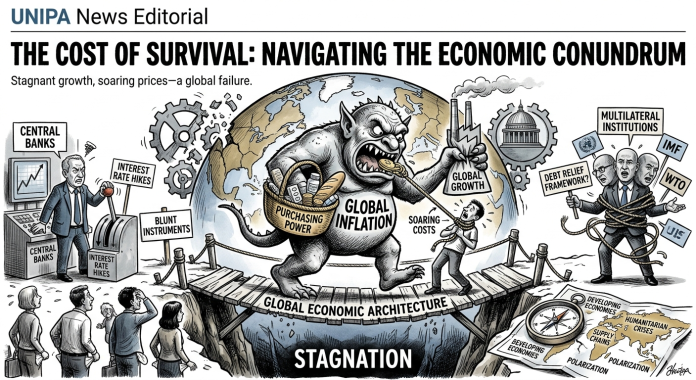

As the global economy stumbles through the second half of the decade, the twin crises of persistent inflation and systemic economic slowdown are no longer merely technical data points on a central bank ledger. They have transformed into a definitive humanitarian and geopolitical challenge. Across both advanced economies and the developing world, the soaring cost of living is actively rewriting the social contract, pushing millions toward the margins, and testing the resilience of international institutions.
We are currently witnessing the fallout of prolonged geopolitical fractures, severely disrupted global supply chains, and the compounding aftershocks of unprecedented fiscal interventions from recent years. The result is a highly volatile economic landscape where traditional monetary tools are proving increasingly blunt. While central banks have aggressively manipulated interest rates to curb inflation, the strategy has inadvertently heightened borrowing costs, suppressed manufacturing, and stalled sustainable growth. We find ourselves trapped in a modern variation of stagflation—where prices refuse to stabilize, yet the engines of real economic progress are running cold.
The most alarming dimension of this crisis is its profoundly unequal distribution. For wealthier nations, inflation manifests as squeezed corporate margins and altered consumer habits. However, for developing and emerging economies, the stakes are existential. Depreciating national currencies, coupled with skyrocketing import costs for essential commodities like food and fuel, have triggered severe balance-of-payments crises. When the cost of basic sustenance outpaces household incomes, economic metrics become human tragedies.
Furthermore, this economic distress is directly feeding into global instability. History demonstrates that prolonged economic deprivation is the primary catalyst for civic unrest, political polarization, and the erosion of democratic governance. When citizens lose faith in the economic architecture to provide basic stability, legal and institutional frameworks inevitably begin to fracture.
To break this cycle, the international community must move beyond isolated, nationalistic monetary policies. Addressing global inflation requires a coordinated, multilateral approach focused on stabilizing global supply networks, implementing comprehensive debt-relief frameworks for vulnerable nations, and investing in structural reforms that foster real productivity rather than speculative growth.
As an international community, the path forward demands a transition from short-term crisis management to long-term economic stewardship. True global security cannot be achieved through military or diplomatic alignments alone; it requires an economic foundation where human dignity, fair market access, and financial stability are guaranteed for all. The current crisis is a stark reminder that in an interconnected world, no economy is an island, and a failure to stabilize the global market is a collective failure to protect our shared future.


