
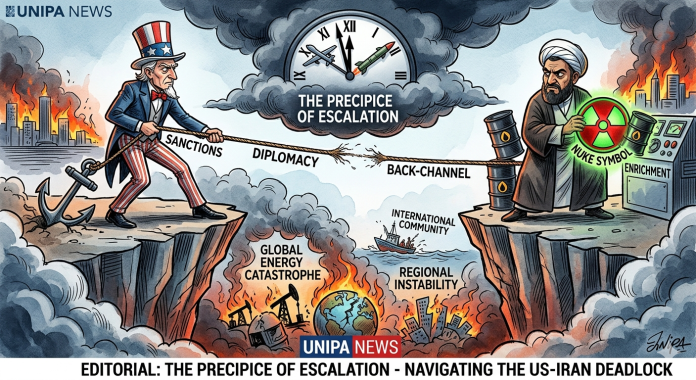

As the global geopolitical landscape shifts in 2026, the long-standing friction between the United States and Iran has once again reached a critical boiling point. What was once a “shadow war” fought through proxies and economic sanctions has evolved into a high-stakes standoff that threatens to engulf the Middle East in a direct kinetic conflict. For the international community, the question is no longer just about diplomacy, but about containment and the prevention of a global energy catastrophe.
A Cycle of Calculated Provocations
The current tension is defined by a dangerous cycle of “tit-for-tat” maneuvers. From the strategic waters of the Strait of Hormuz to the fragmented landscapes of Iraq and Syria, both nations are testing the other’s “red lines.”
- The Nuclear Shadow: With the remnants of previous nuclear agreements fading into obsolescence, Iran’s advancement in enrichment capabilities remains the ultimate trigger for Western concern.
- Technological Warfare: The theater of war has expanded into the digital and autonomous realms. The deployment of advanced drone swarms and sophisticated cyber-attacks on infrastructure has created a new frontier where miscalculation is only a keystroke away.
The Human and Economic Toll
Beyond the military rhetoric, the cost of this prolonged animosity is staggering. The Iranian populace continues to endure the crushing weight of systemic sanctions, while the U.S. finds its strategic focus pulled away from other global priorities. Furthermore, any direct military confrontation risks:
- Global Energy Instability: A disruption in the Persian Gulf could send oil prices to unprecedented heights, triggering a global recession.
- Regional Fragmentation: A full-scale war would likely destabilize neighboring nations, leading to humanitarian crises and a new wave of mass migration.
The Path of De-escalation
The rhetoric of “maximum pressure” or “resistance at any cost” has proven to be a roadmap to a dead end. At UNIPA News, we believe that while the ideological divide is vast, the pragmatic need for stability is greater.
”True sovereignty is not found in the capacity to destroy, but in the wisdom to preserve the future of one’s citizens.”
For a sustainable peace, a multilateral framework must be reinvigorated. Regional actors—including the Gulf states and European intermediaries—must play a more proactive role in facilitating “back-channel” communications to prevent accidental escalation.
The world cannot afford a full-scale war between Washington and Tehran. As military assets gather and rhetoric sharpens, the call for restrained diplomacy must be louder than the drumbeats of war. The lessons of history are clear: in the Middle East, a spark today can become an uncontrollable conflagration tomorrow. It is time for both powers to step back from the precipice and recognize that in a modern conflict of this scale, there are no true victors—only survivors.


