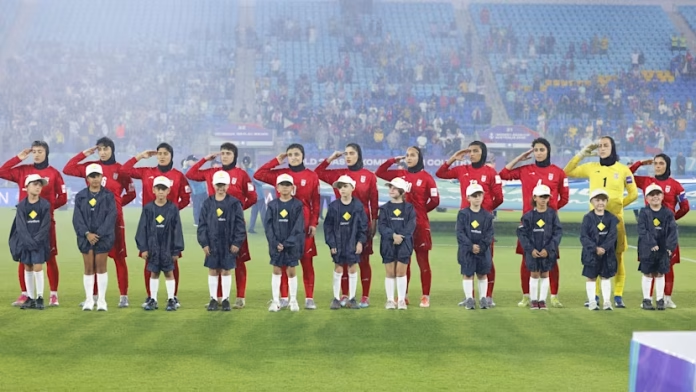

UNIPA News(Sydney): Five players from Iran’s women’s national football team have left the training camp and taken refuge in Australia, according to reports citing Reza Pahlavi, the son of Iran’s ousted shah.
Sources said that earlier on Monday the five players were moved from a hotel on the Gold Coast to a safe house managed by the Australian Federal Police and other authorities.
Concerns over the safety of the team members emerged after some members of the Iranian regime labelled them “traitors” for remaining silent during the national anthem before their first match in the AFC Women’s Asian Cup last week.
Sources also said the team was later forced to sing the national anthem before their second match on Thursday and again before their match against the Philippines on Sunday. Iran lost that match 0–2, and the players were also seen saluting.
Reza Pahlavi called on the Australian government to ensure the safety of the footballers. He identified the five players who left the team for safety as Fatemeh Pasandideh, Zahra Ghanbari, Zahra Sarbali, Atefeh Ramazanzadeh and Mona Hamoudi.
In a post on the social media platform X, Pahlavi said the five courageous athletes are currently in a safe location and have announced their support for Iran’s “Lion and Sun” movement.
The “Lion and Sun” was the original emblem on Iran’s national flag, which was replaced after the 1979 revolution with an emblem representing the word “Allah” and the phrase “Allahu Akbar.”
Earlier, Pahlavi warned that the women could face “dire consequences” if they returned to Iran. He urged the Australian government to ensure their safety and provide them with all necessary support.
Meanwhile, the war involving the United States, Israel and Iran has entered its second week, with little sign of de-escalation.
According to the Iranian Red Crescent, more than 1,200 people have been killed in Iran since the war began on February 28. The attacks came just over a month after Iran’s theocratic government carried out a harsh crackdown on protests that began over the country’s worsening economic crisis and later expanded into broader dissatisfaction with the government.
Several footballers were also among those killed during the protests