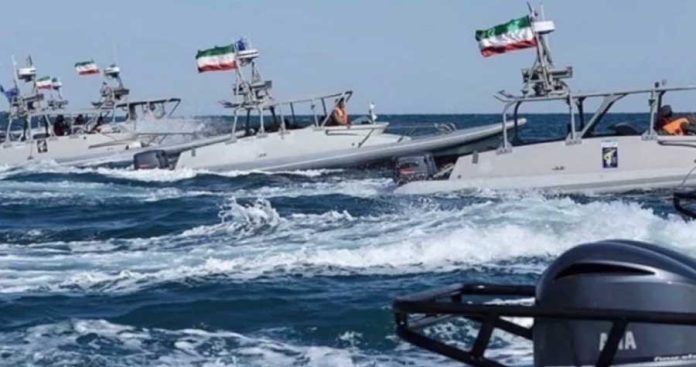

UNIPA News(Tehran), May 8: Iran’s Islamic Revolutionary Guard Corps (IRGC) Navy has claimed that its forces inflicted significant damage on key US naval assets during a joint military operation in the Strait of Hormuz, forcing three American destroyers to retreat from the strategic waterway following what Tehran described as sustained and precise missile strikes.
According to reports carried by Iranian state media, including Press TV, the operation was launched on Thursday evening in response to what Iran described as repeated American provocations and an alleged US attack on an Iranian oil tanker near the port of Jask. The IRGC said the military action was a direct retaliatory measure after multiple warnings to US naval forces were ignored. However, US officials have disputed Iran’s account and said the American warships were not damaged.
In an official statement, the IRGC Navy said the confrontation involved a highly coordinated assault using anti-ship ballistic missiles, cruise missiles, and advanced explosive drones, targeting American destroyers moving through the narrow maritime corridor.
Iranian military commanders alleged that the US naval vessels attempted to advance toward the strait despite explicit warnings from Tehran, prompting Iranian forces to launch what they described as a “precise and large-scale defensive operation.”
The IRGC further claimed that intelligence and surveillance units confirmed serious damage to American military equipment, adding that the intensity of the attack left the US vessels unable to maintain their position.
According to the Iranian statement, the three US destroyers were forced to make an immediate withdrawal under what commanders described as “devastating and accurate firepower.”
Iranian officials identified two primary triggers behind the operation. First, they accused the United States of violating an existing ceasefire framework by allegedly attacking an Iranian oil tanker near Jask Port. Second, they said the continued movement of US naval destroyers toward the Strait of Hormuz, despite Tehran’s explicit restrictions, constituted a direct threat to Iranian sovereignty.
Khatam al-Anbiya Central Headquarters spokesperson Ebrahim Zolfaqari strongly condemned what he described as American “maritime piracy,” warning that the Islamic Republic would respond decisively to any further violations.
“The United States and its allies must understand that any aggression or breach of Iran’s territorial integrity will be met with a powerful and final response,” he said.
The Strait of Hormuz, one of the world’s most strategically important oil transit chokepoints, remains under heightened military tension. Analysts warn that any prolonged disruption in the waterway could have serious implications for global energy markets and regional security.
While Tehran has portrayed the incident as a major strategic victory demonstrating its naval readiness and deterrence capabilities, international observers note that conflicting accounts from Washington and Tehran make independent verification difficult. The latest confrontation nonetheless marks another serious escalation in already fragile US-Iran relations and raises fresh concerns about stability across the Middle East.