
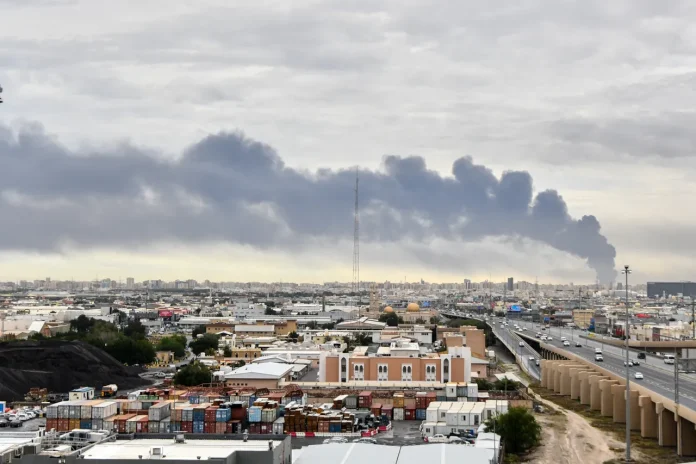

Tensions in the Middle East escalated once again after Iran’s Islamic Revolutionary Guard Corps (IRGC) announced that it had carried out a missile strike targeting a US military base in Kuwait. The attack was described by Tehran as retaliation for an earlier American air operation near Bandar Abbas Airport in southern Iran.
According to Iranian media reports, the strike took place early Thursday morning, only hours after what Iranian officials called a US aerial assault involving projectiles fired at an area close to the strategic port city’s airport.
In a statement, the IRGC warned that the attack was intended to send a clear message to Washington that any form of aggression against Iran would receive a direct response. The group further cautioned that future attacks could trigger even stronger military action.
US military officials had not immediately commented on Iran’s claims. However, earlier on Thursday, an American defense official stated that US forces intercepted four Iranian drones near the Strait of Hormuz after identifying them as potential threats. The official also confirmed that American forces targeted an Iranian ground control facility in Bandar Abbas that was reportedly preparing to launch another drone.
The US described its operations as limited and defensive, insisting that the actions were aimed at preserving the fragile ceasefire currently in place in the region.
The latest confrontation follows a series of military exchanges between Washington and Tehran over recent months. Earlier this week, US Central Command confirmed strikes on missile launch facilities and Iranian boats in southern Iran, claiming the vessels were attempting to deploy naval mines in the Gulf. Iran strongly condemned those operations, calling them a serious breach of the ceasefire agreement.
Meanwhile, diplomatic efforts to permanently end the conflict continue to face uncertainty. Speaking about ongoing negotiations, US President Donald Trump expressed frustration over the slow progress but suggested that the United States remained committed to reaching a final resolution.
Regional instability intensified on February 28 when coordinated US and Israeli attacks targeted multiple sites inside Iran. Tehran responded with waves of drone and missile strikes across the region and temporarily shut down the Strait of Hormuz, one of the world’s most critical oil shipping routes.
Although a ceasefire was later brokered through Pakistani mediation and officially came into effect on April 8, negotiations held in Islamabad failed to secure a long-term peace agreement. Despite extending the truce indefinitely, Washington has continued imposing restrictions on vessels connected to Iranian ports, while uncertainty over a permanent settlement remains.
The renewed exchange of attacks has once again raised fears of a wider regional conflict, with global attention now focused on whether diplomacy can prevent another major escalation in the Gulf.


