
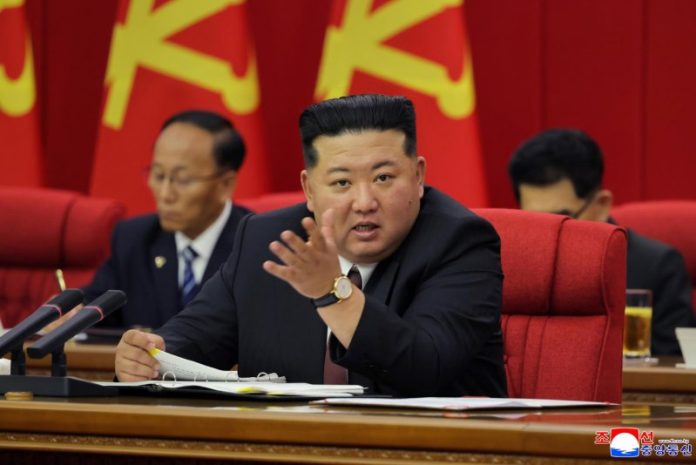

Seoul 23 June*UNIPA News)-North Korean leader Kim Jong Un has called for accelerating the expansion of the country’s nuclear forces, citing growing military cooperation between South Korea and the United States and what he described as an increasingly unstable global security environment.
According to North Korean state media, Kim made the remarks during a plenary meeting of the Ninth Central Committee of the ruling Workers’ Party of Korea, held from Saturday to Monday. The meeting reviewed national objectives for the first half of 2026 and outlined priorities for the remainder of the year.
The gathering reaffirmed Pyongyang’s commitment to strengthening and expanding its nuclear arsenal, which officials described as the foundation of the country’s military sovereignty and deterrence strategy. North Korea maintained that retaining and enhancing its status as a nuclear weapons state is essential for responding to evolving international military and political challenges.
Kim argued that global conflicts, political instability and geopolitical rivalries are increasing security risks, requiring stronger national defense capabilities. He criticized the U.S.-South Korea alliance, pointing to joint military exercises, Seoul’s pursuit of a nuclear-powered submarine and the activities of the bilateral Nuclear Consultative Group, which he accused of developing plans for a nuclear strike against North Korea.
The North Korean leader also accused Japan of moving toward becoming a “war state” and warned that military buildups in Northeast Asia were escalating regional tensions.
Beyond nuclear development, Kim outlined broader military modernization plans, including the construction of a 10,000-ton strategic guided missile cruiser, expanded munitions production and the development of new naval facilities. He also called for the completion of ongoing efforts to strengthen border defenses along the inter-Korean frontier.
The remarks come amid continued North Korean fortification activities near the Military Demarcation Line inside the Demilitarized Zone (DMZ), including the installation of barbed-wire fencing and preparations for mine-laying operations. South Korea’s Defense Ministry has described the activities as a violation of the armistice agreement that ended active hostilities in the 1950-53 Korean War.
Kim further reiterated Pyongyang’s position that South Korea should be regarded as a separate and hostile state, reflecting constitutional changes made by North Korea that removed references to reunification. The comments also signaled continued rejection of outreach efforts by South Korean President Lee Jae Myung.
The developments underscore North Korea’s ongoing focus on expanding its military capabilities and nuclear deterrent amid persistent tensions on the Korean Peninsula and broader security concerns in Northeast Asia.


