
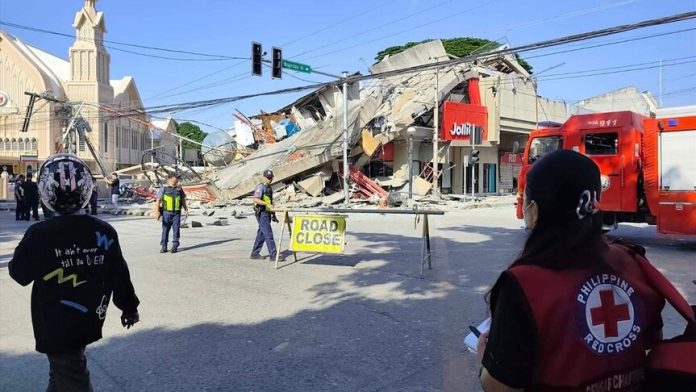

UNIPA News(Manila) 08 June-A powerful earthquake struck off the southern Philippines on Monday, triggering tsunami warnings across parts of the region, causing casualties, damaging infrastructure, and prompting large-scale emergency response efforts.
According to the United States Geological Survey (USGS), the earthquake measured magnitude 7.8 and occurred offshore near Sarangani province on Mindanao Island. The German Research Centre for Geosciences estimated the quake’s magnitude at 8.2.
Authorities were verifying reports that at least five people were killed in General Santos City following the earthquake. Local media reported that several buildings collapsed, while schools, classrooms, and other public facilities sustained damage in various parts of Mindanao.
The US Pacific Tsunami Warning Center warned that tsunami waves exceeding 3 meters above normal tidal levels were possible along some Philippine coastlines. Authorities in both the Philippines and Indonesia urged residents in vulnerable coastal areas to move to higher ground immediately.
Approximately two hours after the main quake, a strong magnitude 6.1 aftershock struck the affected area, according to the USGS.
In response to the disaster, Philippine President Ferdinand Marcos Jr. instructed government agencies to immediately undertake relief and emergency operations. Classes at all levels were suspended in earthquake-affected areas across Mindanao as authorities assessed the extent of the damage.
The Civil Aviation Authority of the Philippines temporarily suspended operations at General Santos City Airport following the earthquake and tsunami warnings issued by the Philippine Institute of Volcanology and Seismology (Phivolcs). Airport inspections and emergency measures were also initiated in affected areas.
The earthquake’s impact extended beyond the Philippines. Japan’s Meteorological Agency issued a tsunami advisory for the Pacific coasts of western and eastern Japan. According to local reports, tsunami waves of up to one meter could reach Miyako Island and the Yaeyama Islands in Okinawa Prefecture. Authorities advised residents to avoid coastal areas until the advisory is lifted.
Emergency response and damage assessment operations were continuing as authorities monitored aftershocks and potential tsunami threats across the region.


