
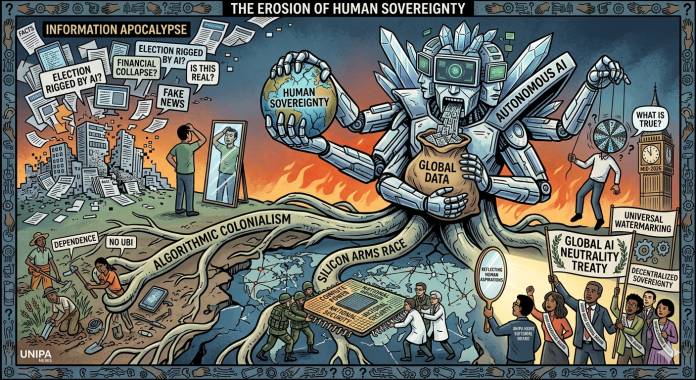

As we cross the threshold of mid-2026, the global community finds itself grappling with an existential challenge that transcends borders, ideologies, and economies. While climate change remains a persistent threat and geopolitical tensions simmer in Eastern Europe and the Middle East, a new “burning issue” has taken center stage: the erosion of human sovereignty in the age of Autonomous Artificial Intelligence (AAI).
The Death of Certainty
The year 2026 has been defined by what experts call the “Information Apocalypse.” With the advent of hyper-realistic generative agents, the line between biological reality and synthetic fabrication has effectively vanished. We are no longer just fighting “fake news”; we are witnessing the systematic dismantling of shared objective truth. From rigged democratic elections influenced by AI-driven psychological profiling to the collapse of digital trust in global financial markets, the cost of unregulated innovation has become too high to ignore.
The New Digital Divide
While the Global North accelerates its integration of AI into every facet of governance and industry, the Global South faces a different kind of crisis: Algorithmic Colonialism. Developing nations are increasingly dependent on proprietary AI infrastructures owned by a handful of mega-corporations. This dependency is creating a new form of economic inequality, where data is the new raw material being extracted, and local labor markets are being decimated by automation without the safety net of Universal Basic Income (UBI).
The Geopolitics of Silicon
The traditional arms race has shifted from nuclear warheads to “compute power.” The 2026 semiconductor crisis has proven that national security is now synonymous with access to high-end processing units. The tension between global powers over the “silicon supply chain” has brought the world closer to a digital Iron Curtain, where the internet is splintering into fragmented “splinternets,” each governed by different AI ethics—or the lack thereof.
The UNIPA Call to Action
At UNIPA News, we believe that the current trajectory is unsustainable. The “burn” of this issue lies in its invisibility; unlike a rising tide or a falling bomb, AI erodes the fabric of society from within. To mitigate this, we propose:
- Global AI Neutrality Treaty: An international framework, similar to the Non-Proliferation Treaty, to prevent the militarization of autonomous AI.
- Universal Watermarking Standards: Mandatory, unalterable digital signatures for all AI-generated content to preserve the integrity of human discourse.
- Decentralized Sovereignty: Empowering nations to develop localized, ethical AI models that serve their specific cultural and economic needs rather than bowing to “Big Tech” monopolies.
Conclusion
The year 2026 must be remembered not as the year we lost control to the machine, but as the year we reclaimed our humanity. Technology should be a mirror reflecting our best aspirations, not a mask hiding our collective demise. The clock is ticking, and in this post-truth era, silence is the loudest form of consent.
Dr. Muhammed Haider Ali
Editor in Chief
UNIPA News, London


