
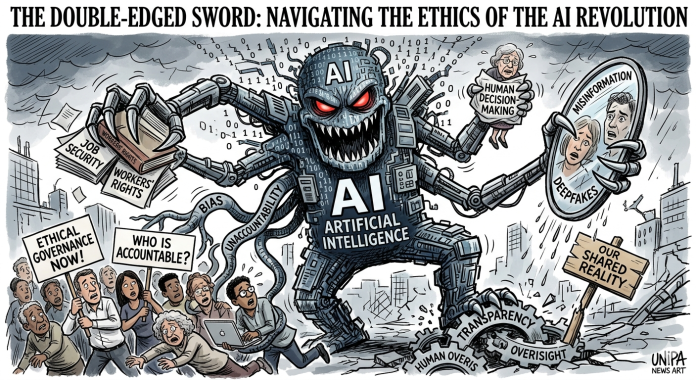

As we move further into 2026, the global conversation has shifted from “What can AI do?” to “What should AI be allowed to do?” For UNIPA News readers, this isn’t just a technical debate; it is a fundamental question of how our society, economy, and personal privacy will survive the most rapid technological shift in human history.
The Innovation Paradox
We are witnessing a golden age of productivity. From medical breakthroughs that identify diseases years in advance to AI-driven solutions for climate modeling, the benefits are undeniable. However, this progress comes with a “black box” problem. As algorithms become more complex, our ability to understand how they make decisions diminishes.
The core issue: When an AI makes a life-altering decision—be it in a courtroom, a hospital, or a hiring hall—who is held accountable when the algorithm is wrong?
The Crisis of Truth
Perhaps the most “burning” aspect of this issue is the erosion of shared reality. The proliferation of hyper-realistic deepfakes and AI-generated misinformation has made the truth a scarce commodity. In an election year for many nations, the ability to distinguish between a human voice and a synthetic one is no longer a luxury—it is a requirement for a functioning democracy.
A Call for Global Standards
Fragmented regulations are no longer sufficient. We need a “Geneva Convention for AI”—a set of global, enforceable standards that prioritize:
- Transparency: Mandatory disclosure of AI-generated content.
- Equity: Ensuring that AI tools do not reinforce historical biases against marginalized communities.
- Human Oversight: Maintaining a “human-in-the-loop” for all high-stakes decision-making.
The Path Forward
The goal should not be to stifle innovation, but to steer it. We must transition from a “move fast and break things” mentality to one of “innovate with intention.”
The future is being written in code, but the ink must be human ethics. If we fail to establish these guardrails now, we risk building a world that is highly efficient, yet fundamentally inhuman.
Editor in Chief
UNIPA News