
Editorial | UNIPA News
This editorial is written for Unipal News, focusing on the escalating global water crisis—a “burning issue” that often sits in the shadow of carbon emissions but poses an immediate threat to human survival.
The Thirst of Nations: Why Water is the Next Global Flashpoint
Editorial | Unipal News
For decades, the world’s geopolitical gaze has been fixed on oil. Nations have risen and fallen over the control of “black gold.” However, as we move further into the 21st century, a more transparent and far more essential liquid is taking center stage. We are entering the era of Blue Gold, and the world is dangerously unprepared for the shortage.
A Scarcity by Design
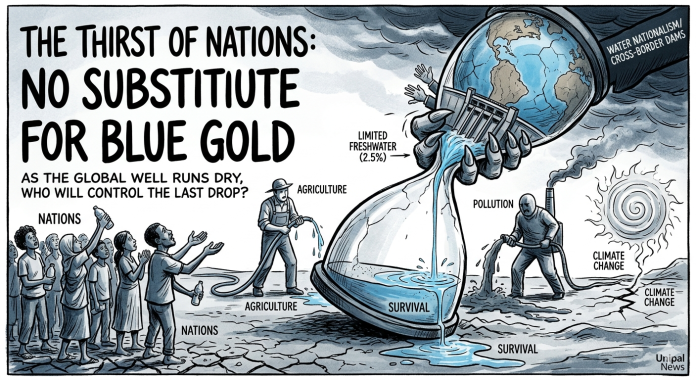
The statistics are no longer just warnings; they are indictments of our collective mismanagement. While Earth is a “water planet,” only about 2.5% of its water is fresh, and much of that is locked in glaciers or deep underground. According to recent UN data, nearly 2 billion people currently live in countries experiencing high water stress.
This isn’t just a “natural” disaster. It is a man-made crisis fueled by:
- Climate Volatility: Shifting rain patterns are turning breadbaskets into dust bowls.
- Agricultural Greed: Agriculture consumes roughly 70% of global freshwater, often using inefficient irrigation methods.
- Pollution: Industrial runoff and untreated sewage are poisoning the limited sources we have left.
The Rise of Water Nationalism
We are witnessing a dangerous trend: Water Nationalism. From the Nile to the Mekong and the Indus, upstream nations are increasingly using mega-dams as geopolitical levers. When a river crosses borders, a dam is not just an engineering feat; it is a statement of power. Without robust international frameworks to govern transboundary water sharing, the next great wars will not be fought over ideologies, but over access to a tap.
The Path Forward: Innovation and Equity
To avert a global catastrophe, we must pivot from “exploitation” to “stewardship.” This requires a three-pronged approach:
- Technological Leapfrogging: Investing in low-energy desalination and advanced wastewater recycling (turning “toilet to tap”) must become a global priority, not just a luxury for wealthy desert nations.
- Valuing Water: We must stop treating water as an infinite free resource. Proper pricing for industrial and luxury use—while protecting the human right to basic needs—is essential to curb waste.
- Diplomatic Proactivity: We need a “Paris Agreement for Water”—a binding international treaty that treats shared watersheds as symbols of cooperation rather than points of conflict.
The Bottom Line: We can survive without oil, and we can transition away from coal. But there is no substitute for water. If the global community does not act now to secure our hydrological future, we are not just looking at an environmental crisis—we are looking at a collapse of civilization as we know it.
The time to fix the leak is before the well runs dry.