

As we navigate the second quarter of 2026, the global community finds itself at a paradoxical crossroads. At the Università degli Studi di Palermo (UNIPA), where our mission is rooted in the “creation and transfer of knowledge for sustainable development,” we cannot ignore the dissonance between our ecological goals and the harsh realities of current geopolitical friction.
The Double-Edged Sword of 2026
The “burning issue” of our time is no longer just the rising global temperature—which, according to recent UN reports, has seen the last eleven years as the hottest on record—but the fragility of the energy transition in a fractured world.
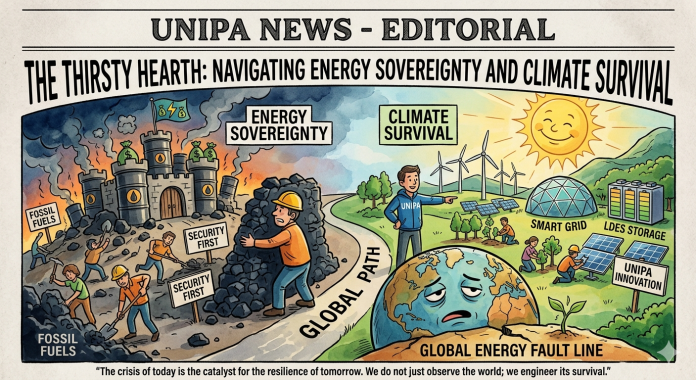
The ongoing crises in the Middle East and Eastern Europe have exposed a “global energy fault line.” For years, the narrative was simple: move away from fossil fuels to save the planet. However, in 2026, the conversation has shifted toward Energy Sovereignty. Nations are scrambling to secure power at any cost, sometimes reviving coal measures to keep the lights on while simultaneously breaking records in solar and wind output.
The UNIPA Perspective: Innovation Over Isolation
From the halls of our Engineering and Economics departments, the data is clear: the energy crisis cannot be solved by retreating into old, carbon-heavy habits. The “economic reckoning” we face today—driven by inflation and supply chain disruptions—is a symptom of our lingering dependence on volatile, finite resources.
- The Climate Reality: “Every major climate indicator is burning red,” as UN Secretary-General António Guterres recently noted. We are witnessing the physical manifestation of this through unprecedented heatwaves across the Mediterranean, impacting our own Sicilian landscapes.
- The Technological Leap: While the risks of AI and misinformation dominate the headlines, it is Smart Grid Technology and Long-duration Energy Storage (LDES) that represent our best defense against both climate change and geopolitical blackmail.
A Call to Intellectual Arms
An editorial in a university press is not merely a record of events; it is a call to action. As researchers, students, and citizens, our responsibility is to bridge the gap between “the lab and real-life problems.”
We must advocate for a “Multilateralism of Technology”—an environment where green innovations are not hoarded as intellectual property but shared as global public goods. If the transition is slower in developing nations due to lack of finance or technology, the entire world remains vulnerable.
Conclusion
The hearth of our global home is indeed burning, but we have the tools to control the flame. The challenge of 2026 is to ensure that our quest for immediate security does not extinguish our hope for a livable future. At UNIPA, we remain committed to the belief that through rigorous science and social awareness, we can turn this energy shock into an energy revolution.
”The crisis of today is the catalyst for the resilience of tomorrow. We do not just observe the world; we engineer its survival.”
Editor in Chief
UNIPA News
April 22, 2026


