
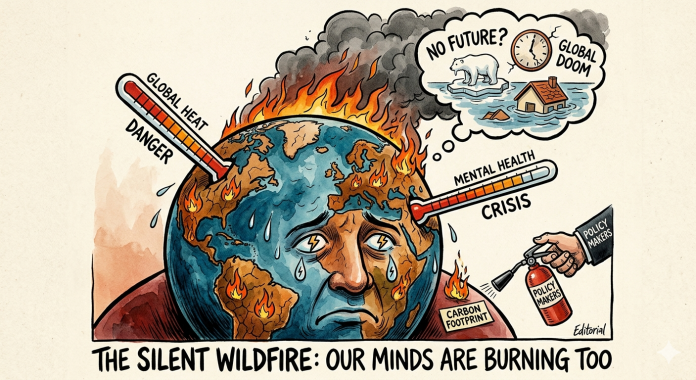

When we discuss the “burning issues” of our planet, we often point to the literal fires in the Amazon or the searing heatwaves across Asia. We talk about carbon credits, renewable energy, and melting glaciers. But there is a silent, internal wildfire spreading across the globe that remains largely undocumented in policy papers: the disintegration of human mental resilience.
The Rise of Eco-Anxiety
For the first time in human history, a significant portion of the global population—particularly Gen Z and Millennials—is experiencing “Eco-Anxiety.” This isn’t just a fleeting worry about the weather; it is a chronic fear of environmental doom. When the future feels like a foregone conclusion of catastrophe, the motivation to build careers, families, and long-term goals begins to erode.
Heat, Humidity, and the Human Temper
Scientific data is beginning to bridge the gap between rising mercury and rising tempers. Studies show a direct correlation between extreme heatwaves and an increase in:
- Violent Crime: High temperatures affect serotonin levels, leading to increased impulsivity and aggression.
- Sleep Deprivation: As nights get warmer, the global “sleep debt” grows, leading to cognitive decline and emotional instability.
- Economic Despair: For those in agriculture or manual labor, a “bad season” isn’t just a headline; it’s a direct hit to their survival, leading to unprecedented rates of depression and rural suicide.
“Solastalgia”: Homelessness at Home
We are familiar with nostalgia—longing for a past time. But philosophers have coined a new term for our era: Solastalgia. It is the distress caused by environmental change while you are still at home. It is the feeling of a farmer watching his fertile land turn to dust, or a coastal resident watching the sea swallow their childhood porch. It is a profound sense of loss without ever having moved.
“We are not just losing our habitats; we are losing our sense of place in the universe.”
Beyond the Carbon Footprint
For decades, the climate conversation has been clinical and mathematical. We’ve focused on $CO_2$ parts per million and Celsius targets. While these are vital, we have ignored the Human Spirit. To survive the coming decades, our “Green New Deals” must include:
- Mental Health Infrastructure: Psychological support for climate refugees and disaster survivors.
- Community Resilience: Moving away from individualistic survivalism toward collective local support systems.
- Nature-Based Therapy: Integrating urban greenery not just for cooling, but as a mandatory tool for public mental sanity.
The Bottom Line
The climate crisis is no longer just an “outside” problem. It is under our skin and in our heads. If we manage to save the planet but lose our collective sanity in the process, have we truly won? It’s time to realize that cooling the planet and calming the human mind are two sides of the same coin.
The Earth is burning, and so are we. It’s time to put out both fires.


