
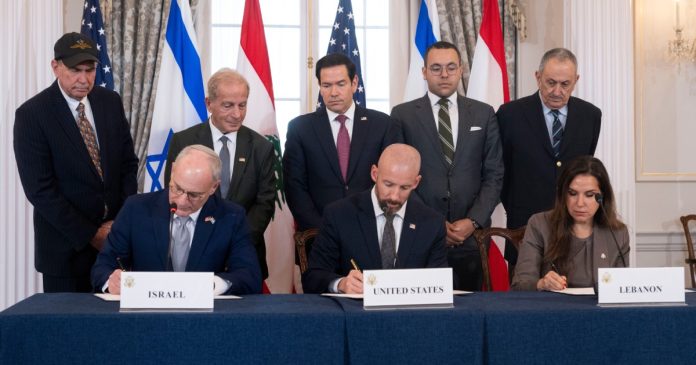

UNIPA News || WASHINGTON, June 26 — The United States, Israel and Lebanon on Friday announced a framework agreement aimed at reducing tensions along the Israel-Lebanon border and laying the groundwork for a broader peace process following months of conflict between Israel and the Lebanese armed group Hezbollah.
The agreement, signed in Washington by Israeli Ambassador Yechiel Leiter and Lebanese Ambassador Nada Hamadeh Moawad in the presence of US Secretary of State Marco Rubio, establishes a mechanism for dismantling Hezbollah’s military infrastructure and restoring Lebanese state authority in areas affected by the conflict. The United States will facilitate a newly formed Military Coordination Group for Lebanon and provide US$100 million in humanitarian assistance to support implementation.
According to the US State Department, the framework is intended to create conditions for Lebanon to reassert sovereignty over its territory while addressing Israel’s security concerns along its northern border.
Israeli Ambassador Leiter described the agreement as the beginning of a path toward lasting peace between the two countries. He said Israel’s eventual withdrawal from southern Lebanon would depend on Hezbollah being disarmed and the Lebanese Armed Forces assuming full responsibility for security in the area.
Lebanese Ambassador Moawad said the framework represents an initial step toward restoring Lebanon’s sovereignty and territorial integrity, securing a permanent cessation of hostilities, facilitating the return of displaced residents, and promoting long-term peace and stability.
Despite the agreement, Hezbollah rejected the process. Hassan Fadlallah, a member of the group’s parliamentary bloc, said Hezbollah opposes direct negotiations between Lebanon and Israel and will not surrender its weapons. He warned that enforcing the agreement could risk internal conflict in Lebanon.
The latest round of fighting began after Hezbollah launched rocket attacks into Israel following the outbreak of regional hostilities involving Iran. The conflict has resulted in thousands of deaths in Lebanon and dozens of Israeli military casualties, while prompting Israel to expand its military presence in southern Lebanon.
Lebanese officials have consistently prioritized securing a complete Israeli withdrawal from southern Lebanon, while Israel has insisted that any lasting arrangement must include Hezbollah’s disarmament.
Lebanese Prime Minister Nawaf Salam said the agreement seeks to ensure Israel’s withdrawal from Lebanese territory, restore state sovereignty, and enable displaced citizens to return home. He added that Lebanon is committed to extending the authority of the state, through its armed forces, across the entire country.
Lebanese President Joseph Aoun recently confirmed that discussions are underway regarding proposed “pilot zones,” where the Lebanese army would gradually assume exclusive security responsibilities as Israeli forces withdraw, subject to Israeli approval.
Israeli Prime Minister Benjamin Netanyahu welcomed the framework, describing it as a significant achievement for Israel. He said Israeli forces would maintain a security zone in southern Lebanon until Hezbollah is fully disarmed and no longer poses a threat, while allowing the Lebanese army to begin preparations for assuming control in designated pilot areas.
The framework marks the latest diplomatic effort to stabilize the Israel-Lebanon border, although its implementation is expected to face significant challenges due to Hezbollah’s continued opposition to disarmament.


